Everyone Thinks “Research Use Only” Is a Loophole for Sellers. It’s Actually Two Loopholes, and Nobody’s Watching the Second One.


This is an explainer and one writer’s read of the public record, not legal or medical advice. It is not affiliated with Biotech Peptides or any provider named here, and it links to no one’s store. Every claim about the law and the science links out to a primary source: FDA letters and a press release, an approved drug label, peer-reviewed journals, and the vendor’s own site. Some compounds discussed are research chemicals not approved for human use, and the supervised medications discussed require a prescription. Last updated June 2026.
Everyone in this corner of the internet says the same thing about “for research use only.” They say it’s a wink. A nudge. A legal fig leaf that everybody, buyer and seller alike, silently agrees to pretend is real so the sale can happen. Fine. That part’s not even controversial anymore, and I’ll get to why.
But here’s where I think most people, even the ones who are properly suspicious of research peptides, are still wrong. They think the disclaimer is covering one hole: the legal one. It’s not. It’s covering two, and the second one is the one that’ll actually hurt you.
I spent a week reading warning letters, statutes, and journal conclusions to figure out which hole is which. Let me walk you through it, because the distinction changes what you should actually be worried about.
The obvious hole: it’s not a legal shield, it’s a lane marker
Start with the company that’s at least honest about what it is. Biotech Peptides says on its own site that “all products are sold for research, laboratory, or analytical purposes only, and are not for human consumption,” and that it is “a chemical supplier…not a compounding pharmacy or chemical compounding facility” [1]. Credit where due: that’s more upfront than most of the category. Nobody’s pretending to be a clinic.
But here’s the trick, and it’s a trick even when it’s stated honestly. A chemical sold for lab use doesn’t have to clear the bar a drug does. No mandatory review of identity, strength, quality, or purity for human use, because on paper nobody’s putting it in a body. The label is the toll booth that keeps the product in that cheaper, unreviewed lane. It’s not protecting the swimmer. It’s protecting the pool.
Then, in 2026, the regulator stopped playing along.
On March 31, 2026, the FDA sent a warning letter to a seller called Gram Peptides, stating that products it offered, including retatrutide and tirzepatide, are unapproved new drugs under section 505(a) of the Federal Food, Drug, and Cosmetic Act [2]. The interesting part isn’t the company, it’s the reasoning. The FDA leaned on section 201(g)(1), which says a product becomes a “drug” when it’s intended to affect the structure or function of the body, and that intent gets inferred from context: the marketing, the claims, the whole page, not just the sticker. The same day, a comparable letter went to another seller, Prime Sciences [3].
So the disclaimer-as-legal-shield theory is dead. The agency read past the sticker. I want to be precise here, because precision is the whole point of this exercise: those letters named Gram Peptides and Prime Sciences. Not Biotech Peptides. I’m not implying otherwise. What matters is the reasoning applies to the model, not just to whoever happened to get caught first.
There was a parallel front worth noting too. Earlier, the FDA warned 30 telehealth companies over illegal marketing of compounded GLP-1 products, including claims implying equivalence to FDA-approved drugs [4]. That one’s a useful gut check, because it proves the rule cuts both ways. Supervised doesn’t mean automatically fine. It means the claims have to be true on both sides of the line.
Fine. That’s the hole everyone already half-suspected. Here’s my concession, and then here’s the hole nobody’s talking about.
My honest concession
I went in wanting to write “the disclaimer is a scam.” That’s too simple, and it’s not quite what the record shows. The disclaimer isn’t fraudulent, it’s doing exactly what it was built to do: keep the seller in a regulatory lane where review requirements are lighter. That’s not illegal by itself. Selling a chemical labeled for lab use is a real business model with a real legal basis, right up until the marketing or the buyer’s actual use makes the human-use intent obvious. The FDA didn’t declare the entire research-chemical category illegal. It declared that the sticker doesn’t override context. That’s narrower than “it’s all a scam,” and I should say so.
The second hole: the one the legal conversation quietly buries
Here’s my actual thesis, and it’s the thing that got lost while everyone argued about legality. Even if you decided you were fine with the legal gray zone, personally, you still haven’t solved anything, because the product was never checked for identity, strength, quality, or purity in the first place. There’s no clinician evaluating whether it’s appropriate for you. No prescription. No dispensing pharmacy. No follow-up. If a vial is mislabeled, underdosed, or contaminated, there’s no recall authority and nobody accountable. A seller’s certificate of analysis is a document the company chose to publish, not an outside guarantee, and independent testing of gray-market compounds has a long, unflattering history of finding products that don’t match their labels.
That’s a second, separate gap. It’s a purity-and-accountability gap, and the “for research use only” label doesn’t just dodge the legal question, it also quietly dodges this one, because the whole premise is that nobody’s supposed to be checking whether it’s safe for a human, since no human is supposed to be involved. One sticker, two holes. Most people only clock the first.
Is the science at least good enough to make the risk worth it?
I checked, because if the evidence were strong, I’d have to soften my case. It mostly isn’t, and that’s its own answer. Take BPC-157, the recovery peptide these sites push hardest. A 2025 systematic review in the HSS Journal went through 36 studies, found 35 of them preclinical and only one a small clinical study of 12 patients, and concluded that “no clinical safety data were found” [8]. A 2025 narrative review in Current Reviews in Musculoskeletal Medicine landed in the same place: only three pilot human studies exist, “human data are extremely limited,” and the compound “should be considered investigational” [9].
Now put that next to the metabolic peptides, because the contrast is the whole argument in miniature. Semaglutide and tirzepatide are peptides too, GLP-1 receptor agonists working through the incretin system to suppress glucagon, slow gastric emptying, and increase fullness [5]. SURMOUNT-1 reported tirzepatide weight reductions of 15.0% to 20.9% across doses at 72 weeks, versus 3.1% on placebo [6]. Retatrutide, still investigational, produced a mean 17.5% reduction at 24 weeks in a Phase 2 trial [7].
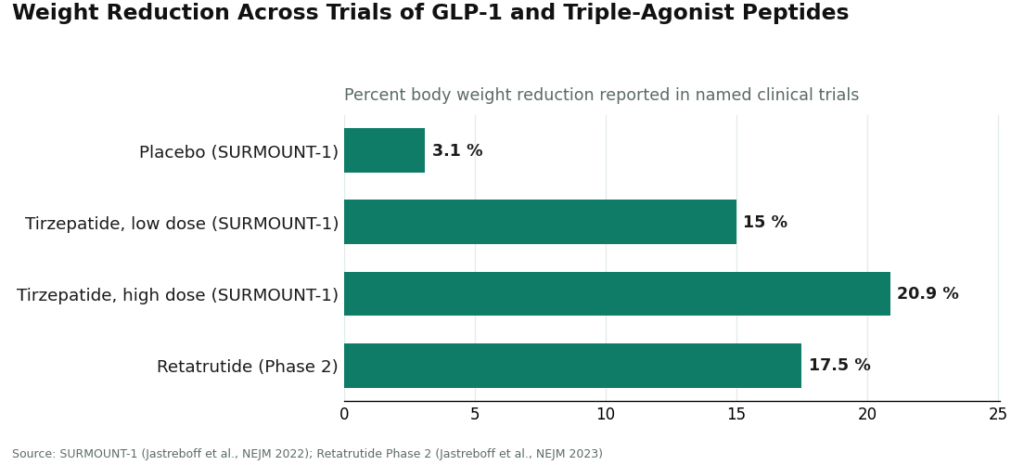
Notice what’s different about these two groups of peptides. It’s not the molecule type. It’s that one group went through the slow, expensive, boring process of actual trials, and the other group got sold under a sticker that exists specifically to skip that process. The legal gap and the data gap turn out to be the same gap, wearing two different outfits.
So where’s the lane that isn’t gray on either count?
It’s the unglamorous one: a licensed clinician decides whether a compound is appropriate, writes a prescription when it is, and a licensed pharmacy dispenses it, with follow-up after. That structure doesn’t make every compound magically proven, and I won’t pretend it does. What it does is close both holes at once. Someone with a license and a name is accountable for what you’re taking, and that person actually has to look at the approved label. Semaglutide’s carries a boxed warning for thyroid C-cell tumors and contraindications for anyone with a personal or family history of medullary thyroid carcinoma or MEN 2 [10]. A research-chemical checkout page has never asked you that question. A clinician has to.
FormBlends is one provider organized around that supervised model, offering access to peptide, GLP-1, and hormone options through a clinician and a licensed pharmacy rather than as a lab chemical. I’m naming it once, as an example of the structure, not as a product recommendation and not as a link to anything you can buy from me.
Where I land
Everyone treats “for research use only” as a single, simple loophole. It’s actually two loopholes stacked on top of each other, a legal one that the FDA has now explicitly said doesn’t survive contact with obvious human-use marketing [2][3][4], and a quieter purity-and-accountability one that never gets fixed just because you’ve made peace with the legal risk. Solving one doesn’t solve the other. The only lane that closes both is the boring one, with a clinician and a pharmacy attached. Read the fine print yourself. That’s the one piece of advice here I’d stake anything on.
Questions that come up a lot
Does “for research use only” protect me if I’m the one using the peptide? No, and this is the part people keep getting backwards. It protects the seller’s legal position, keeping the product in a lab-supply lane that sits outside drug regulation. The instant you use it on yourself, the label was never written with you in mind, and the FDA’s own position is that the product then functions as an unapproved new drug [2][3].
Did the FDA really say the disclaimer doesn’t hold up? Functionally, yes. In its March 31, 2026 warning letters to research-peptide sellers, the agency cited section 201(g)(1) of the Federal Food, Drug, and Cosmetic Act, which defines a “drug” by intended effect on the body’s structure or function, an intent inferred from surrounding marketing, not from a sticker alone [2]. The agency reads the whole page. The sticker doesn’t get the final word.
Was Biotech Peptides one of the companies named? No. The March 31, 2026 letters named Gram Peptides and Prime Sciences [2][3]. What matters here is the legal reasoning, which applies to the sales model broadly, not a verdict on any one company that wasn’t mentioned.
Does a certificate of analysis prove the vial is what it claims? Not by itself. It’s a document the seller chose to publish, not an independent check, and gray-market samples have a documented track record of not matching their labels. Since these products sit outside drug regulation, there’s no required review of identity, strength, quality, or purity for human use, and no recall authority if something’s wrong with the batch [2][3].
Is the science on something like BPC-157 strong enough to justify the legal gray zone? Mostly not. A 2025 systematic review in the HSS Journal covered 36 BPC-157 studies, found 35 preclinical and just one small clinical study, and concluded no clinical safety data existed [8]. A 2025 narrative review agreed, calling human data extremely limited and the compound investigational [9]. Compare that to semaglutide and tirzepatide, which carry large human trial datasets the research chemicals simply don’t have [6].
What actually separates the supervised route from buying a vial under a disclaimer? A name attached to the decision. A licensed clinician evaluates whether the compound fits you, writes a prescription if it does, and a licensed pharmacy fills it, with follow-up afterward. That matters concretely: approved labels carry real warnings, like semaglutide’s boxed warning for thyroid C-cell tumors and its contraindications for anyone with a personal or family history of medullary thyroid carcinoma or MEN 2 [10]. A checkout page never asks that question. A clinician has to.
Is Biotech Peptides legit, or is it a scam?
It’s a real company shipping real vials, so “scam” isn’t quite the right word. The sharper question is what you’re actually buying. Their products are sold strictly for research purposes, not human use, and that disclaimer isn’t decoration, it shifts all liability onto you the second you open the box. Real doesn’t mean safe, and it definitely doesn’t mean appropriate for you personally.
What do Biotech Peptides reviews actually tell you, and what do they leave out?
Most reviews are about shipping speed and whether the package showed up intact, which is useful if you’re a credentialed researcher stocking a lab. What they almost never cover is batch-to-batch purity consistency, whether a third-party certificate is authentic, or what you’re supposed to do if something goes wrong medically. The review culture around these vendors was built for buyer experience, not for safety.
What is the best alternative to buying from research-peptide sites like Biotech Peptides?
The most accountable path runs through a licensed physician who can prescribe via a compounding pharmacy, because that puts an actual medical professional between you and the compound. Some people use services like FormBlends, which work under physician supervision and pharmacy oversight instead of the research-chemical model. It costs more and requires a real consultation, but you get dosing guidance, a paper trail, and someone to call if it goes sideways.
Where should I buy peptides instead if I want something intended for human use?
You need a prescription and a licensed compounding pharmacy, no way around it. A polished-looking website selling vials marked “not for human consumption” is not a substitute for that, no matter how legitimate the branding looks. Start with a telehealth provider or your own doctor, get a real workup, and if a peptide therapy fits, they’ll route you to a pharmacy compounding under FDA oversight. That’s the only channel where human-use accountability actually exists.
References
- Biotech Peptides. Terms and Conditions / product disclaimer (“sold for research, laboratory, or analytical purposes only, and are not for human consumption”). biotechpeptides.com.
- U.S. Food and Drug Administration. Warning Letter to Gram Peptides (CMS #721806), March 31, 2026. https://www.fda.gov/inspections-compliance-enforcement-and-criminal-investigations/warning-letters/gram-peptides-721806-03312026
- U.S. Food and Drug Administration. Warning Letters to online peptide sellers marketing GLP-1 products labeled “research use only,” issued March 31, 2026 (including Prime Sciences). https://www.fda.gov/drugs/drug-alerts-and-statements/fdas-concerns-unapproved-glp-1-drugs-used-weight-loss
- U.S. Food and Drug Administration. “FDA Warns 30 Telehealth Companies Against Illegal Marketing of Compounded GLP-1s.” Press announcement, February 20, 2026.
- Mahapatra MK, Karuppasamy M, Sahoo BM. Semaglutide, a glucagon-like peptide-1 receptor agonist with cardiovascular benefits for management of type 2 diabetes. Rev Endocr Metab Disord. 2022;23(3):521-539.
- Jastreboff AM, Aronne LJ, Ahmad NN, et al. Tirzepatide Once Weekly for the Treatment of Obesity (SURMOUNT-1). N Engl J Med. 2022;387(3):205-216.
- Jastreboff AM, Kaplan LM, Frias JP, et al. Triple-Hormone-Receptor Agonist Retatrutide for Obesity, A Phase 2 Trial. N Engl J Med. 2023;389(6):514-526.
- Vasireddi N, Hahamyan H, Salata MJ, et al. Emerging Use of BPC-157 in Orthopaedic Sports Medicine: A Systematic Review. HSS J. 2025.
- Regeneration or Risk? A Narrative Review of BPC-157 for Musculoskeletal Healing. Curr Rev Musculoskelet Med. 2025.
- U.S. Food and Drug Administration. WEGOVY (semaglutide) injection, full prescribing information (Boxed Warning, thyroid C-cell tumors; contraindications).